
 ,
,


 3D-printing
Choose a location to see what’s possible there for 3d-printing, which facilities are available, and what’s useful to coordinate in advance.
 Spaarndamseweg 120 A11-A122021 KA Haarlem
 info@the-owls-nest.nl
 +31 23 369 0 269Tugelastraat 552021 TB Haarleminfo@the-owls-nest.nl+31 23 369 0 269
 3D printing can produce prototypes, replacement parts, enclosures, fixtures, small tools and limited series. The useful work begins before the printer moves: defining the purpose, obtaining or making a suitable model and choosing a process.
Different printers and materials serve different purposes, and prints may occupy equipment for many hours. Select a location to see its printers, material options, design support and working arrangements.
An existing STL or 3MF file can sometimes be prepared directly, but many useful projects start with an object that must be measured, a model that must be modified or a new part that must be designed. A printable shape also needs suitable clearances, wall thickness, strength and assembly details.
Test size, shape, fit or interaction before committing time and material to a final version.
Measure and redraw a broken or unavailable component while accounting for force, heat, movement and attachment.
Create a housing, bracket, guide, jig or adapter that connects electronics, mechanics or an existing object.
FDM builds parts from layers of molten filament. It is commonly useful for prototypes, functional parts and enclosures, with visible layer direction and process-specific strength.
Resin printing can produce much finer detail, but requires different handling, washing, curing and attention to material safety.
PLA, PETG, nylon, filled materials and different resins vary in strength, temperature resistance, flexibility and preparation. Print orientation affects strength, surface quality, support material and duration. Slicing is therefore a design decision rather than a final automatic step.
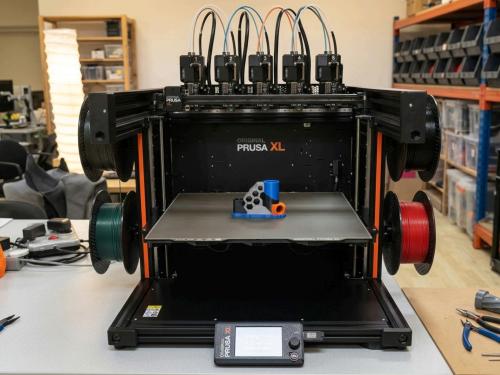
Spaarndamseweg is a fixed base for filament printing and practical prototyping. A Prusa XL with two toolheads is based here, making the location useful for larger parts, projects that benefit from the XL build volume and prints that use the prepared dual-tool arrangement.
Bring an STL, 3MF or STEP file where available, together with the intended dimensions and what the part must withstand. Orientation, supports, toolhead use and print duration are assessed before a long job is committed to the printer.
Prints can run for many hours or longer than a day. The printer therefore needs to be scheduled even when the design and slicing work fit within a single appointment.
Filament may need to be brought from storage or set aside for the project. PLA, PETG, nylon and some more specialised filaments have formed part of the wider stock, but a specific colour, brand, quantity or technical material should be brought or arranged.
Nylon and certain copolymers require drying before printing. Mention such materials early so preparation time is included rather than discovered at the start of the appointment.
For detailed design work, measuring and redrawing a replacement part, resin printing or combining a print with precision electronics, see Tugelastraat. Its local 3D printing setup complements the larger filament printer at Spaarndamseweg.
Tugelastraat combines 3D design with filament and high-detail resin printing. The local emphasis is on measuring, modelling and producing parts that belong to a repair, enclosure, electronic project or prototype—not only on sending an existing file to a printer.
A Prusa MK4S is available for prototypes, enclosures, fixtures and functional parts. A small basic stock of PLA and PETG supports ordinary tests and smaller projects.
Special colours, technical filaments or larger quantities should be brought or arranged in advance.
An Elegoo Saturn 4 16K is available for detailed resin work. Resin printing also requires controlled handling, washing and curing, so the post-processing plan forms part of the appointment.
A small selection of common resins is available; a particular mechanical property, colour or specialist resin should not be assumed to be in stock.
An existing model can be modified, or a replacement part can be measured and redrawn. Clearances, wall thickness, orientation, supports and the forces or temperature involved are considered before the print is treated as a final repair component.
Bring the original part or mating object when accurate fit matters, and provide STL, 3MF or STEP files where available. Prints can run beyond the appointment and must be scheduled accordingly.
Spaarndamseweg has a Prusa XL with two toolheads and can be a better fit for a larger filament part or a project suited to that build volume and setup. Both locations are described on the 3D printing capability page.
3D printing often connects with General repair, Electronics, Digital and Science and experiments when resins, casting or material behaviour are being investigated.
Copyright © 2026, ASK-Solutions · The Owl’s Nest is an initiative of ASK-Solutions


 Privacy Policy