
 ,
,


Choose a location to see additional information that applies there.
 Paul Krugerstraat 362021 XN Haarlem
 info@the-owls-nest.nl
 +31 23 369 0 269Spaarndamseweg 120 A11-A122021 KA Haarleminfo@the-owls-nest.nl+31 23 369 0 269Tugelastraat 552021 TB Haarleminfo@the-owls-nest.nl+31 23 369 0 269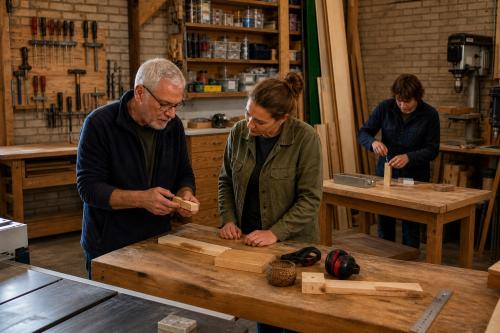
A shared workshop works when people can concentrate, ask questions and trust that their workspace and boundaries will be respected. Operators and locations can organise this in different ways, while remaining connected through principles that support careful work and meaningful participation.
Choose a location to see how its scale, atmosphere, access and activities shape the local way of working together.
Noise, dust, fumes, sparks, strong odours, long materials and changing a shared setup can affect more than one workbench. These activities are coordinated before they begin so the surrounding space can be prepared.
Workpieces, cables, tools and materials are arranged so routes, controls and common facilities remain accessible. At the end of a session, tools return to their place and the workspace is left ready for its next use.
People may work at different tempos and with different levels of experience. Questions and conversation are welcome, while concentration, personal space and a clear request to pause or stop are taken seriously.
People use equipment that fits their current experience and the activity being carried out. Unfamiliar tools and machines begin with instruction or joint use. A process stops when something behaves unexpectedly, a guard or extraction system is not working properly, or the user no longer feels able to continue safely.
Medication, fatigue, stress or another circumstance can affect alertness, coordination or reaction time. Where this matters for the activity, it can be discussed privately so the work, equipment and level of support can be adjusted.
Intimidation, uncontrolled aggression and participation while under the influence of alcohol or non-prescribed drugs are incompatible with a shared technical workspace. When someone cannot participate safely at that moment, the work pauses and another route or time can be considered.
A person may come to finish a practical job, learn a first technique, regain confidence around tools or contribute knowledge to someone else’s project. These purposes can exist beside one another when expectations are clear and the local capacity is respected.
Accessibility can involve physical access, the arrangement of a workbench, the level of background activity, clear instructions, extra time or planned breaks. Locations describe their own possibilities because the building, workspace and activities are different.
Paul Krugerstraat is the most visibly active workshop environment of the three locations. Conversation, walk-in visits and practical work can take place alongside projects involving wood, metal, glass, bicycles or vehicles. Clear coordination keeps those different forms of activity compatible.
Machine work, grinding, welding and automotive activity can affect the whole room through noise, movement, sparks or occupied floor space. These processes are announced and prepared so people can move safely and protect work that needs concentration.
The standard arrangement can be adapted for a wheelchair or walker when this is known in advance. Materials and projects remain within an agreed area so access routes and shared controls stay clear.
The workshop can also provide a practical environment for meeting people, becoming familiar with materials and tools, or rebuilding participation through manageable activity. Paul Krugerstraat is one of the locations represented under Learning and rebuilding. The relevant pages explain how practical learning, rhythm and capacity can develop without turning ordinary workshop use into a treatment programme.
When someone needs a quieter technical setting or a project dominated by detailed electronics or screen work, Tugelastraat or Spaarndamseweg may fit better.
Spaarndamseweg is appointment-based and generally more predictable than an open workshop floor. The session, participants and required equipment can be known in advance, allowing the room to be prepared around focused repair, electronics, 3D printing or glass work.
Access passes through a central hall that must remain properly closed. Arrival, departure and movement of equipment are coordinated so the building remains secure and shared access routes are not obstructed.
Work that produces noise, dust, soldering fumes or strong odours is arranged around the local extraction, ventilation and other people using the setting. Cables, computer setups and partly disassembled equipment remain organised so the fault can be reproduced without creating trip hazards or losing parts.
The location can host several people, but capacity depends on the activity. A soldering or repair session can require more supervision and table space than a meeting or demonstration. The appointment therefore defines who is participating, how the space will be used and which setup should be ready.
If another environment becomes more suitable during the project, the next step can be coordinated with Paul Krugerstraat for heavier physical work or Tugelastraat for precision, electronic or digital development.
Tugelastraat is a small working environment shared by technical projects, digital work, consultation, design and precision work. In principle, up to two people can be physically present at the same time, depending on the activity, required guidance and ongoing work.
Electronic boards, measured parts, resin work, computer setups and project files can remain sensitive to interruption or accidental movement. Visitors coordinate before using another person’s bench, tools, components or digital equipment.
The setting allows a project to move between conversation, drawing, programming, measurement and making. Short questions can be handled during opening hours, while longer work is planned so it does not conflict with meetings or other technical tasks.
Tugelastraat is also one of the locations represented under Learning and rebuilding. Conversation can help define a realistic project, while focused technical, digital and creative work can provide concrete ways to practise learning methods or rebuild concentration and capacity.
People who need support with access, calm or the use of the workspace can discuss this in advance. Larger or noisier machine work is referred to Paul Krugerstraat so the local environment can retain its focused character.
See How it works for planning a visit or project and Tools and machines for the shared approach to equipment and process safety. Questions about a local arrangement can be discussed through Make an appointment.
Copyright © 2026, ASK-Solutions · The Owl’s Nest is an initiative of ASK-Solutions


 Privacy Policy