
 ,
,


 Science and experiments
At the moment, there is no location available for science and experiments. We’re working to make this possible again soon. Keep an eye on the website or get in touch for the latest status.
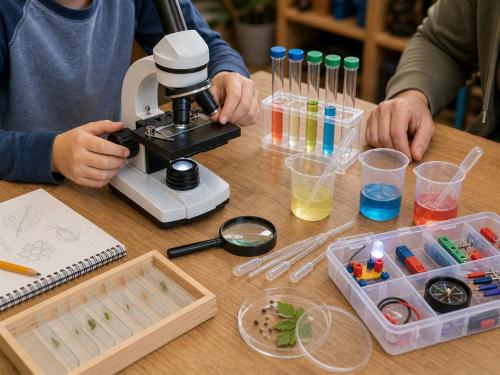 Science and experiments covers controlled observation, measurement and practical investigation. It can involve substances, materials, light, heat, electricity, microscopic structures or the preparation of ingredients used in technical and creative work.
The capability is not an umbrella for every project that uses scientific knowledge. Its focus is the experiment or investigative process itself: asking a question, changing or preparing something under controlled conditions and observing the result. Select a location to see its local form.
A stereo microscope can support inspection of surfaces, fibres, small mechanisms, crystals or repair details. A compound microscope can make biological or prepared samples visible at a different scale.
Substances can be dissolved, separated or purified to understand a mixture or prepare material for another process. Temperature, solvent choice and contamination matter.
Experiments may involve resins, cleaning processes, pigments, metal salts, castings or substances used in glass painting and other creative applications.
Small solar panels, coloured flames, spectra, rainbows, heat and other visible effects can make physical and chemical principles tangible.
A useful experiment identifies what is being changed, what is being observed and which conditions should remain comparable. Notes, photographs and simple measurements make the result easier to interpret and repeat.
Demonstrations can also be valuable when the purpose is to make a phenomenon visible. A coloured flame, hydrogen generation, a rainbow made with water droplets or a small solar-panel test can prompt questions even when the setup is not formal research.
Scale and substances matter. An experiment that is suitable as a small controlled demonstration may be unsuitable at a larger quantity, higher concentration or different temperature.
Using a microscope to inspect a solder joint remains primarily Electronics when the purpose is circuit repair. Inspecting crystals, fibres or biological samples is more directly science and experiments. An Arduino project is electronics and digital when the controller itself is central, but also connects here when it is used to measure or control an experiment.
Preparing a metal salt for stained-glass pigment can combine this capability with Glass art. Resin formulation or casting can overlap with 3D printing or repair. The primary question is what the activity is trying to understand or achieve.
Chemicals, flames, gases, pressure, heat, glassware, ultraviolet light and biological material can each require specific controls. An interesting effect is not enough reason to perform an experiment. Substances, quantities, waste, ventilation, protective equipment and the possibility of an unexpected reaction must be considered first.
Activities for children or beginners should use a scale and method that make observation possible without turning hazard into spectacle. More advanced preparation or chemical work requires clear identification of materials and a plan for handling, storage and disposal.
For longer practical exploration, see Learning through practice. For the general principles around equipment, preparation and supervised use, see Tools and machines.
Copyright © 2026, ASK-Solutions · The Owl’s Nest is an initiative of ASK-Solutions


 Privacy Policy