
 ,
,


Materials, parts, tools and equipment may be needed directly for an activity, make a repair possible or help ensure that something remains available for future use. They certainly do not always need to be new. Existing items that are still genuinely useful can be just as valuable.
What is useful depends on the purpose. A used SSD, a tool, an electronic component or an offcut of material may fit a specific need exactly. A request may specify a particular material or piece of equipment that is needed. A campaign may welcome materials and equipment over a longer period or for several parts of the same activity.
The useful type, size, version or condition is therefore described as clearly as possible. Storage space, safety, compatibility and the condition of the material also matter. This helps prevent well-intentioned contributions from ultimately going unused.
For machines, large quantities of material or items whose usefulness is not immediately clear, it is best to contact the relevant operator or location first. That way, it can be checked in advance whether there is actually a need and enough space.
You can also view all requests, including requests where several kinds of contribution are possible.
Materials and equipment often only gain real value when people start working with them. In our practical examples we show how contributions, practical help and knowledge have come together to produce concrete results.
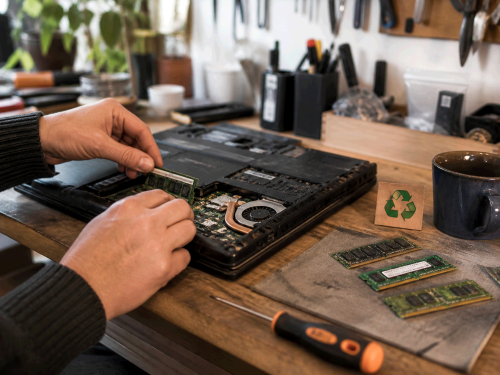
A request for RAM, laptops, desktop PCs and accessories to repair usable hardware, put it back to work and, where possible, pass it on.
Copyright © 2026, ASK-Solutions · The Owl’s Nest is an initiative of ASK-Solutions


 Privacy Policy