
 ,
,


 Woodworking
Choose a location to see what’s possible there for woodworking, which facilities are available, and what’s useful to coordinate in advance.
 Paul Krugerstraat 362021 XN Haarlem
 info@the-owls-nest.nl
 +31 23 369 0 269Tugelastraat 552021 TB Haarleminfo@the-owls-nest.nl+31 23 369 0 269
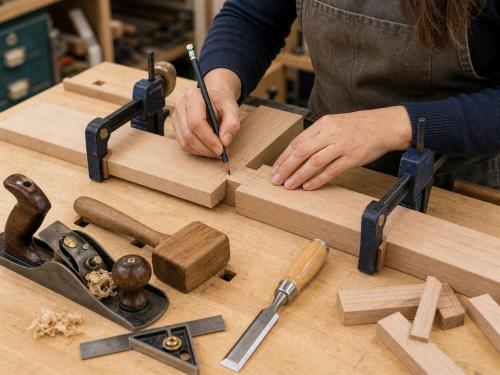 Woodworking can range from repairing a loose joint or making an accurately fitting replacement part to carving, shaping, routing, turning and building a larger object. It brings together material knowledge, measurement, tool control and decisions about how a piece should be assembled and finished.
Different locations may emphasise fine handwork, repairs, larger construction or particular machines. Select a location to see which forms of woodworking can take place there and what kind of workspace, equipment and guidance apply.
Wood is not uniform. Grain direction, moisture, hardness, defects and the way a part will be loaded affect how it can be cut, joined and finished. Good woodworking therefore begins before the first cut: with looking, measuring, marking out and choosing a method that fits both the material and the intended result.
Correct a loose joint, restore an edge or make a small wooden component that is no longer available. Accuracy is often more important than removing material quickly.
Saws, planes, chisels, knives and rasps provide direct feedback through resistance, sound and the surface they leave behind.
Choose simple fastenings or deliberate wood joints according to strength, appearance, repairability and the skills the project is meant to develop.
Routing, turning, sanding and finishing can define profiles, surfaces and final fit. A good finish starts with careful preparation.
A drawing can explain a sequence, but practical skill develops through repeated contact with the material. You learn to notice whether a saw is following the line, whether a chisel is cutting cleanly, how tightly a joint should fit and which surface preparation is needed before finishing.
Machines can make some operations faster or more repeatable, but they do not replace planning, secure clamping or an understanding of the direction in which a tool acts. Higher-risk machines and unfamiliar tools are used only after appropriate instruction and, where necessary, together with someone who has relevant experience.
Paul Krugerstraat provides the broadest physical woodworking setup within The Owl’s Nest. It is suited to repairs, small furniture, prototypes, jigs, shaped parts and construction work that requires a proper bench, more room around the workpiece or several different operations.
The available or prepared setup can include:
Not every machine is necessarily set up or free at every moment. If your plan depends on one particular machine, confirm this before bringing the material.
Workbenches, measuring and marking tools, saws, chisels, planes, drills, sanders and other portable tools support fitting, assembly and operations that are easier to control by hand or directly on the workpiece.
Bring your own wood, sheet material and project-specific fittings. Common consumables such as drill bits and sandpaper may be available, but a particular wood species, router bit, grit, dimension or finish should be brought or arranged in advance.
Some tools can be used independently after explanation. Higher-risk machines and unfamiliar operations are used together or under supervision. Large sheet material, repeated machine work and projects that create substantial dust need advance coordination.
For carving, hand-cut joints, fine replacement parts and compact detail work, also see Woodworking at Tugelastraat. That location has a smaller precision-oriented setup rather than the broader machine workspace found here.
Woodworking at Tugelastraat is fine, compact and precision-oriented. It is suitable for small workpieces, repair parts, carving, hand-cut joints and detailed finishing where accurate measuring, marking and fitting matter more than open floor space or large machines.
The local tools include chisels and specialist chisel sets, Japanese and other hand saws, marking knives, gauges, squares, measuring tools, hand planes and woodcarving tools. A Tormek sharpening system is available for maintaining controlled cutting edges.
Finer tools are used carefully and, where appropriate, together with someone familiar with their adjustment and use.
Small routers can produce profiles, decorative edges and other details, while a scroll saw supports shaped and internal cuts. Typical projects include hand-cut dovetails, carved details, small wooden replacement parts and precise correction of fit.
Bring your own wood and other project-specific materials, or bring the partly completed project. Tugelastraat does not keep a general stock of timber or sheet material. A limited supply of common screws and glue is available for small jobs and repairs.
You may use the tools at the location and are also encouraged—but not required—to bring personal tools you already know, such as a woodcarving knife or carving set. Coordinate unusual tools, finishes or materials in advance.
Large constructions, substantial sheet material and work that depends on a table saw, planer, drum sander, wood lathe or broader machine setup belong at Paul Krugerstraat. See the Woodworking capability page for both local forms.
The workshops below involve woodworking. Which other capabilities are included varies by workshop.
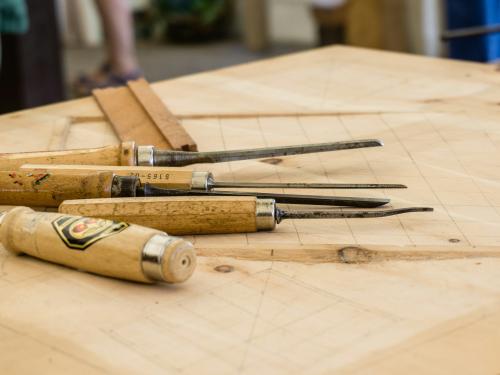 Woodworking brings together measuring, marking, cutting, shaping, fitting and other practical techniques for working with wood.
Below are projects in which woodworking plays a role. Projects are built up and developed over time; how this capability is used or combined with other capabilities varies from project to project.
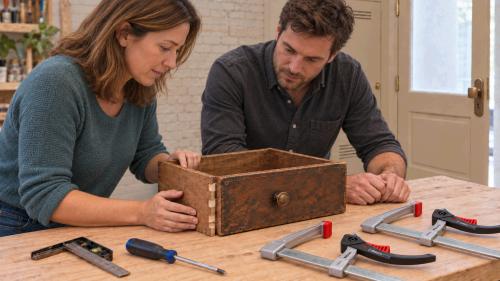
The repair project at The Owl’s Nest – Paul Krugerstraat brings together knowledge, ownership and reuse through practical and craft-based repair, from bicycles and small furniture to metalwork, stained glass and larger household appliances.
Bring your own project material unless a workshop description explicitly states that material is included. A sketch, sample, damaged part or existing object can make the project easier to assess.
Large sheet material, substantial constructions and work requiring a great deal of open space should always be discussed in advance.
A wooden project may also involve Metalworking for brackets, Visual arts for carving or surface design, 3D printing for a jig or replacement part, or General repair when several materials meet.
You can approach woodworking through your own project, a guided workshop, repeated practical learning or volunteering around shared activities. See Use the workshop, Learning through practice and Volunteering.
Copyright © 2026, ASK-Solutions · The Owl’s Nest is an initiative of ASK-Solutions


 Privacy Policy