
 ,
,


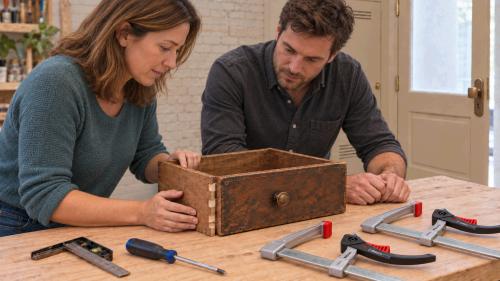 Repair is a project within ASK-Solutions’ implementation of The Owl’s Nest at the Paul Krugerstraat location. Here, broader questions concerning knowledge, ownership, responsibility and reuse take practical form through hands-on and craft-based repair.
A broken object makes these questions concrete. How was it made, where is the problem, what knowledge or skills are needed, and can the object be repaired or adapted so that it remains useful? The project therefore connects with ASK-Solutions’ broader focus on people, makers and communities.
ASK-Solutions aims to make knowledge understandable, useful and transferable. The page on knowledge and free technology describes how access to knowledge gives people greater room to investigate, make choices and pass knowledge on.
In practical repair, much of this transfer happens directly through the work. Someone can learn how a construction fits together, why a joint becomes loose, how a material can be worked or which steps are needed to make a damaged component fit again.
This connects directly with the goal of repair, ownership and reuse. Ownership becomes more meaningful when people have realistic opportunities to maintain, restore, adapt and keep an object useful.
Alongside this local practice, ASK-Solutions runs the foundation-wide Repair and Ownership project. It explores ownership and dependency more broadly, including technology, software, services and access to parts and knowledge. This repair project connects with the same questions through practical workshop activity.
At this location, the emphasis is on repairs centred on materials, construction and practical craft work. Woodworking, metalworking, welding, bicycles, glass work and other craft capabilities can be combined where useful.
A damaged component can be dismantled, adapted, refitted or remade. A wooden part can be restored, a metal fixing modified, a construction welded again or a damaged component made to fit once more.
The tools, working methods and local capabilities are described in more detail under General repair and the other capabilities available at the location.
Repair Cafés make repair accessible through organised sessions in which visitors and volunteers work together on broken objects. Within its implementation at Paul Krugerstraat, ASK-Solutions has chosen a permanent community workshop in which repair can form an ongoing part of projects, learning and practical work.
This format allows a repair to continue across several working sessions. A construction can first be investigated, then dismantled and later restored when materials, parts or an appropriate solution are available. A repair can also become an opportunity to learn a technique in greater depth or to make a replacement component.
ASK-Solutions therefore does not organise a Repair Café at this location. The permanent community workshop gives this implementation of The Owl’s Nest room for making, learning, investigation and knowledge sharing over longer periods.
Repairs within this project connect with the capabilities of the workshop. Over the years this has included, for example:
A coffee machine, vacuum cleaner or toaster may, for example, involve both electrical and mechanical problems. Where the investigation primarily requires extensive electronic diagnostics, fine soldering or circuit-board work, the repair project at The Owl’s Nest – Tugelastraat is better suited.
A repair does not always depend on a ready-made replacement component. Existing parts can sometimes be adapted or restored, while simple components can be recreated when the available materials and techniques allow it.
This can extend the useful life of objects while keeping practical knowledge in circulation. Repair reveals how something was constructed, which materials were used and which choices are needed to create a workable solution.
Practical knowledge becomes visible at the workbench. Someone can observe how a joint is assessed, dismantle something themselves, take a measurement, work a material or help with reassembly and testing.
Experience moves in several directions. A visitor may know bicycles, furniture making, welding or a particular material. A volunteer may demonstrate a technique that is new to others. A beginner may ask questions that reveal steps experienced makers have come to regard as obvious.
A repair therefore provides both a concrete object to work on and an opportunity for knowledge and skills to move between people.
Repair can keep materials, components and the energy already invested in an object useful for longer. The condition of the object, safety, available materials and its expected remaining life together help determine an appropriate approach.
The resulting solution must also remain responsible to use. Each repair therefore takes account of the construction, loads and risks associated with the object and the techniques used.
This repair project brings several ASK-Solutions principles together through practical and craft-based work. Objects remain useful for longer, people learn how they are constructed and knowledge about materials, construction and repair can be passed on.
Within ASK-Solutions’ implementation of The Owl’s Nest at Paul Krugerstraat, repair is one way in which the broader goals concerning knowledge, ownership and reuse take practical form. Current facilities and capabilities are described under General repair.
This project relates to several capabilities from the shared work model that forms part of the The Owl’s Nest project. These capabilities describe recognisable areas of knowledge, practical skills and facilities that may play a role in carrying out a project. Through Repair, Bicycles, Woodworking, Metalworking, Welding, Glass art, Ceramics you can read more about what these capabilities mean and how their practical implementation may differ between operators and locations.
Copyright © 2026, ASK-Solutions · The Owl’s Nest is an initiative of ASK-Solutions


 Privacy Policy