
 ,
,


 Ceramics
At the moment, you can use ceramics at one location. Below you’ll see what’s usually possible there, which facilities are available, and what you can arrange in terms of materials or consumables.
 Paul Krugerstraat 362021 XN Haarlem
 info@the-owls-nest.nl
 +31 23 369 0 269
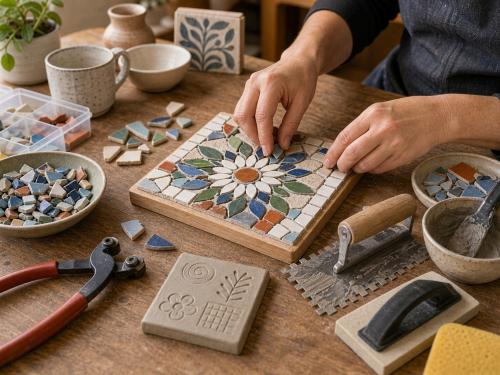 Ceramics is the broader capability for work with fired clay and ceramic materials. It currently provides a natural thematic home for mosaic and can also accommodate pottery and other ceramic activities as those are developed.
The capability page does not imply that every ceramic process or piece of equipment is present. Select a location to see which local interpretation and related activities are explicitly described.
Mosaic translates a drawing or arrangement into separate pieces with joints between them. Colour, shape, direction and spacing determine whether the finished surface feels balanced and whether the intended image remains readable.
A design must fit the base, available material and the size at which pieces can realistically be cut and placed.
Tiles are cut or nipped into useful shapes, then arranged so colour, spacing and direction work together before adhesive fixes the design.
Grout closes the joints and changes the appearance. Colour, cleaning and curing contribute to a solid and readable result.
Mosaic is not the same as pottery, but both belong within ceramics because they use ceramic materials and processes shaped by making, drying, fixing or firing. The capability can therefore remain stable while individual activities are added, changed or offered at different locations.
Future pottery work may involve forming, joining, drying, decorating, glazing and firing clay. Those processes have their own material and equipment requirements and should be described through actual location bodies and workshop definitions rather than assumed from the badge alone.
The current local form of ceramics at Paul Krugerstraat is mosaic. Ceramic tiles and, where suitable, glass pieces are cut or nipped and arranged on a prepared base before being fixed with adhesive and completed with grout.
A planned mosaic workshop includes use of the cutting and nipping tools and basic materials such as tiles, adhesive, grout and a suitable small base. The activity is arranged so sharp fragments, adhesive and grouting can be handled in a controlled way.
For your own project, bring the base and the exact tiles, ceramic pieces or glass colours you want to use. Also consider whether the finished object will remain indoors or needs materials suitable for moisture or weather.
The local ceramics capability does not currently describe pottery, wheel throwing, general clay work or a ceramic firing programme. Those activities would require their own equipment, materials and location-specific definition rather than being inferred from the mosaic setup.
The workshops below involve ceramics. Which other capabilities are included varies by workshop.

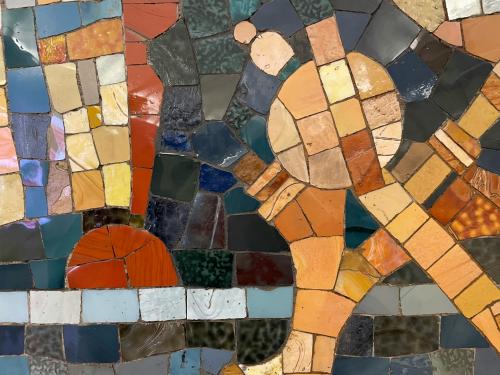 Mosaic combines pieces of tile, glass and other suitable materials into a composed pattern, image or surface.
Below are projects in which visual arts plays a role. Projects are built up and developed over time; how this capability is used or combined with other capabilities varies from project to project.
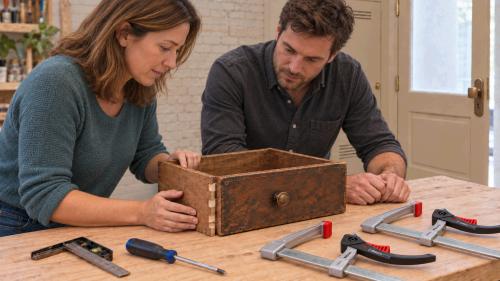
The repair project at The Owl’s Nest – Paul Krugerstraat brings together knowledge, ownership and reuse through practical and craft-based repair, from bicycles and small furniture to metalwork, stained glass and larger household appliances.
For mosaic work, consider the base, dimensions, intended use, design, material and whether the finished object will remain indoors or face moisture and weather. Bring project-specific ceramic or glass pieces, adhesive and grout unless a workshop states that these are included.
Ceramics can connect with Visual arts through colour and composition, Glass art when glass is used in mosaic, and Science and experiments through pigments, glazes and material behaviour.
Copyright © 2026, ASK-Solutions · The Owl’s Nest is an initiative of ASK-Solutions


 Privacy Policy