
 ,
,


 Electronics
Choose a location to see what’s possible there for electronics, which facilities are available, and what’s useful to coordinate in advance.
 Spaarndamseweg 120 A11-A122021 KA Haarlem
 info@the-owls-nest.nl
 +31 23 369 0 269Tugelastraat 552021 TB Haarleminfo@the-owls-nest.nl+31 23 369 0 269
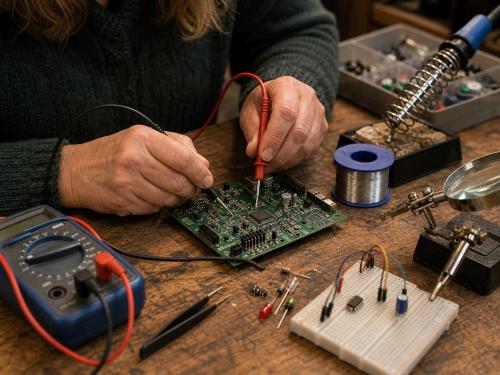 Electronics includes building, measuring, modifying and repairing circuits and the connections around them. A project may be as small as replacing a cable or connector, or may combine sensors, controls, software, a power supply and a custom enclosure.
Soldering is one part of the capability, but good electronics work also depends on inspection, measurement and understanding how power and signals move through a circuit. Select a location to see its local scope.
A visibly damaged part can be useful evidence, but it is not always the cause of the failure. Diagnostics can involve checking connectors and wiring, measuring supply rails, examining signals, testing under load and comparing observed behaviour with documentation.
Multimeters, oscilloscopes, generators, analysers, laboratory supplies and electronic loads can reveal voltage, current, waveform and behaviour under controlled conditions. A measurement should answer a question, not merely produce a number.
Assemble wires, connectors, through-hole parts and surface-mount components with suitable temperature and clean surfaces.
Remove and replace parts without lifting pads or damaging nearby components, using magnification and controlled heat where needed.
Combine sensors, actuators and controllers such as Arduino or Raspberry Pi in small functional projects.
An Arduino project is primarily electronics when the circuit, power, inputs and outputs are central. It also involves Digital when software and data become central, and Science and experiments when it is used as an instrument to measure or control an experiment.
Enclosures and mounting can involve 3D printing; repairing a complete product may also involve General repair. The overlap is useful, but each capability keeps a different primary focus.
Spaarndamseweg has a fixed soldering station and a calm appointment-based workspace for cable work, small electronic assemblies and repairs that need to be tested together with a computer or complete device.
The setup can support suitable work on wires, connectors, switches, through-hole components and bounded circuit-board repairs. It is also useful for making or repairing cables and for small electronics projects where the wiring and enclosure need to remain organised.
Bring the components, connectors and project-specific parts you expect to use. Do not assume that an unusual connector, integrated circuit or replacement module is kept at this location.
A repaired cable or board can often be tested with the power supply, computer, enclosure or other equipment to which it belongs. This makes the location useful when the symptom only appears in context.
For hot-air rework, desoldering, microscope inspection, oscilloscope measurements, controlled power supplies, electronic loads or a wider component stock, see Tugelastraat and the Electronics capability page.
Bring the device or board safely packed, together with all adapters, cables and available documentation. Work involving mains voltage, damaged batteries or another elevated risk must be described before the appointment.
Tugelastraat is the main location for electronics diagnostics, precision soldering, rework and development. The workbench combines soldering and inspection equipment with measuring instruments, a stock of common parts and the digital and 3D-design facilities often needed around a complete project.
The local equipment includes Weller soldering stations and a Weller rework station with a hot-air pencil and desoldering gun. A trinocular microscope with camera supports inspection of solder joints and detailed SMD work.
Special screwdrivers, proprietary bits and device-opening tools help reach boards and connectors without causing unnecessary damage to housings and snap-fit constructions.
Test equipment includes digital and analogue oscilloscopes, a function generator, a frequency analyser, a laboratory power supply and an electronic load. These tools can be used to inspect signals, verify power supplies, analyse frequency behaviour and test a circuit under a controlled load.
The parts stock contains many common resistors, fuses, connectors, plugs, cable materials and other small components useful for diagnosis and repair. Project-specific integrated circuits, modules and unusual connectors still need to be brought or ordered.
Arduino, Raspberry Pi, sensors and simple controls can be combined with programming and a 3D-printed enclosure. The same bench can therefore support both repair and a new development project.
For straightforward soldering, cable work or electronics tied to a computer in a calmer appointment-based setting, see Spaarndamseweg. Bicycle lighting or an e-bike display repair may begin at Paul Krugerstraat and be continued here when detailed electronics work is required.
Bring the complete device or test setup, including its power supply, cables and documentation. Mains voltage, damaged batteries, charged capacitors and other elevated risks must be described before the appointment.
The workshops below involve electronics. Which other capabilities are included varies by workshop.

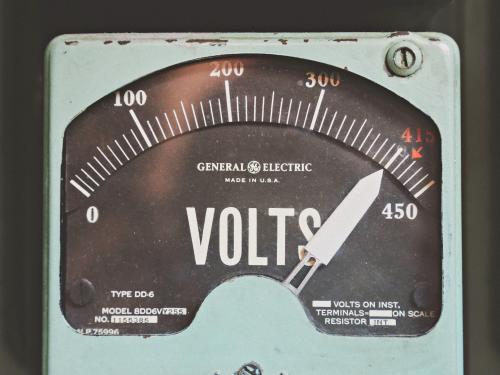 Electricity introduces the basic principles behind electrical systems and how they can be recognised, investigated and approached safely in practical work.


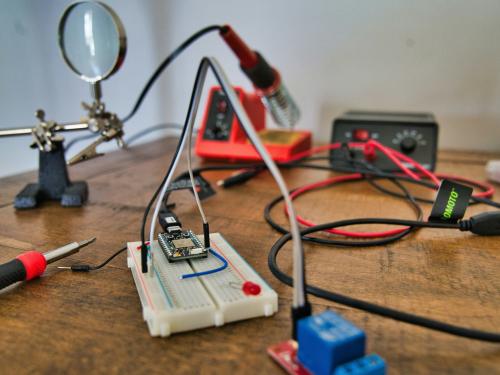 Soldering centres on making and assessing electrical connections, with attention to preparation, heating, the solder joint and inspection.
Below are projects in which electronics plays a role. Projects are built up and developed over time; how this capability is used or combined with other capabilities varies from project to project.
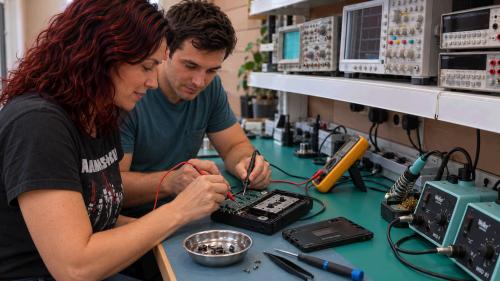
The repair project at The Owl’s Nest – Tugelastraat focuses on computers, software, websites, electronics, electrical equipment and fine mechanical and electromechanical repair.
Electronics can involve mains voltage, charged capacitors, batteries, heat and components that are easily damaged by incorrect handling. The circuit and power source determine whether the work is suitable and which precautions apply.
Clear photographs, board markings, schematics, pinouts and notes about measurements help prevent repeated work and make an investigation transferable. When possible, bring the complete device, its power supply and accessories, a description of the fault, previous test results and any relevant documentation.
Copyright © 2026, ASK-Solutions · The Owl’s Nest is an initiative of ASK-Solutions


 Privacy Policy