
 ,
,


 Metalworking
At the moment, you can use metalworking at one location. Below you’ll see what’s usually possible there, which facilities are available, and what you can arrange in terms of materials or consumables.
 Paul Krugerstraat 362021 XN Haarlem
 info@the-owls-nest.nl
 +31 23 369 0 269
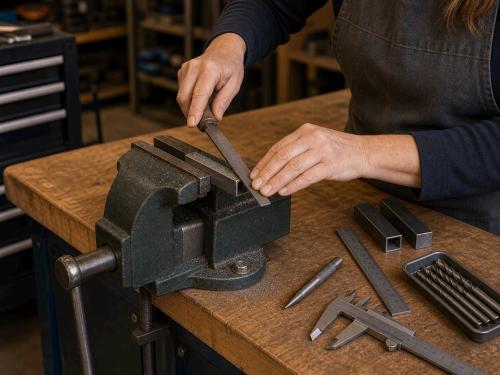 Metalworking covers small-scale making, repair and adaptation of metal parts. A project may involve drilling a precise hole, shortening a bracket, cutting a profile, correcting a fit or producing a small part through turning or milling.
The capability does not imply a production workshop or every possible machine process. Material, dimensions, tolerances, noise, sparks and setup all affect what is suitable. Select a location to see the local forms of metalworking.
Metal parts are often less forgiving than they first appear. A hole drilled in the wrong position, a surface ground too far or a part cut without allowing for finishing may be difficult to correct. Useful preparation includes a sketch, reliable measurements, an understanding of how parts fit together and a clear order of operations.
Reference edges, hole positions and clearances determine whether a part will fit. Checking before cutting or drilling is part of the work.
Saws, shears, drills, files and grinders separate material or create the features needed for an assembly.
Turning and milling can produce controlled dimensions and surfaces. Deburring and finishing remove sharp edges and prepare a part for use.
Not every dimension needs the same precision. A decorative bracket, sliding shaft, threaded fitting and structural connection each require a different understanding of acceptable fit. It is useful to identify which measurements are critical and which can remain approximate.
Material also matters. Steel, stainless steel, aluminium, brass and unknown alloys respond differently to cutting, heat and surface treatment. Where the material cannot be identified reliably, the available methods may need to remain conservative.
Metalworking at Paul Krugerstraat is intended for small-scale repair, fabrication and adaptation. It is suitable for drilling, cutting, grinding, fitting and preparing parts for assembly or welding, rather than production runs or large-scale manufacturing.
The milling machine and lathe require explicit advance confirmation because their setup can depend on ongoing building work, space and the job itself. Drilling, cutting, grinding and smaller handwork are generally easier to arrange.
The local tools include several cordless angle grinders, a cordless straight grinder with a Roloc system, cordless drills, a cordless shear, bench and sheet-metal hammers, a planishing hammer, files and hacksaws.
These are useful for adapting brackets, plates and profiles, removing sharp edges, correcting fit, preparing a surface and completing work before or after welding.
Bring the metal you intend to work on and, where known, state whether it is steel, stainless steel, aluminium or another material. A sketch, sample or mating part is often more useful than a verbal description alone. Bring job-specific abrasives, cutters or other consumables when the operation depends on a particular type or size.
Very small repair operations, such as shortening a metric screw precisely or finishing a small round component, may fit the precision-repair setup at Tugelastraat. Its small metal lathe is used as repair equipment and is not a separate general metalworking facility.
Work that creates substantial sparks, noise or hot material is coordinated so protective equipment, clear space and supervision are available. For joining prepared parts, see Welding.
Below are projects in which metalworking plays a role. Projects are built up and developed over time; how this capability is used or combined with other capabilities varies from project to project.
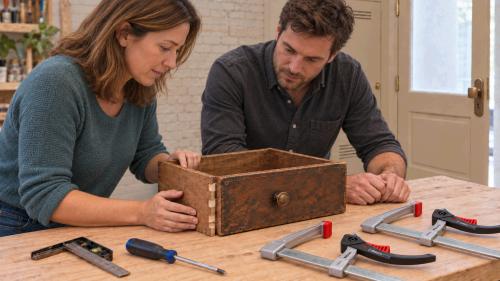
The repair project at The Owl’s Nest – Paul Krugerstraat brings together knowledge, ownership and reuse through practical and craft-based repair, from bicycles and small furniture to metalwork, stained glass and larger household appliances.
Metalworking often prepares parts for Welding: edges are cleaned, pieces are fitted and clamped, and the completed joint may need grinding or finishing afterwards.
It also supports General repair and Automotive when a bracket, spacer, fastening or other component must be adapted or reproduced.
Metalworking can produce sharp edges, swarf, heat, noise and sparks. The applicable setup and protective measures depend on the operation. See Tools and machines for the general principles.
Copyright © 2026, ASK-Solutions · The Owl’s Nest is an initiative of ASK-Solutions


 Privacy Policy