
 ,
,


At present, no operator or location has information available for science and technology.
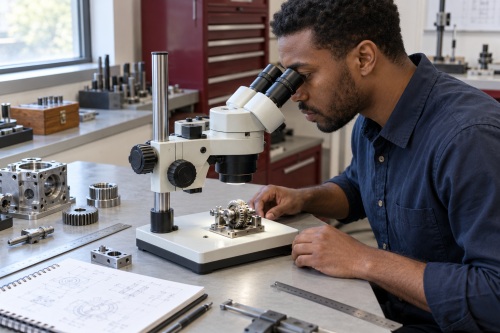 Science and technology is about investigating how things work and about designing, making, maintaining and adapting materials, structures and systems. Asking questions, measuring and testing ideas sit alongside practical problem solving, engineering and craft knowledge. Scientific inquiry and technical work are different, but they can meet in the same practical activity.
Within the shared work model, these approaches appear in diagnosis, fabrication, instrument making, electronics, digital work and experiments. Sometimes the technical task is central; sometimes a question is explored further by measuring, testing, comparing and changing the design.
With these capabilities, investigating, measuring, designing, making, maintaining or adapting are already central parts of the work.


Repair, vehicles, bicycles, electronics and digital work directly involve understanding systems, measuring, investigating faults, diagnosis, maintenance and adaptation. Mechanical, electrical, electronic and digital parts can be explored separately or together.


Wood, metal, welding, glass, ceramics, textiles and 3D printing make technology tangible through measuring, shaping, joining, construction and material behaviour. Design and practical use are closely connected throughout the work.

Music connects directly with technology through instrument building, adaptation and repair, as well as inquiry into sound. Resonance, structures, electronics and electromechanics can all become part of the work.

Science experiments centre on observation, measurement, forming questions and investigating and testing hypotheses. Practical setups and results can be used to understand phenomena and develop further questions.
With these capabilities, the relationship develops when material behaviour, optics, growing conditions or other measurable processes become deliberate subjects of investigation or design.


Visual arts and gardening connect with science and technology when material behaviour, optics, growing conditions or measurable processes become subjects of inquiry or design. The question being explored shapes the connection.
Copyright © 2026, contributors to The Owl’s Nest · Powered by Nocterra 


 Privacy Policy