Fit-check for referrers

Nederlands, English
Donate with PayPal

For employers

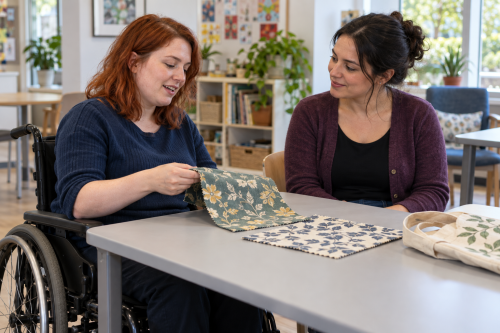
Photo of absence due to stressWhen an employee gets stuck due to stress, (imminent) absence or overload, it often does not help to “talk about it” or “just get back to work”. What does help is a place where someone can practise calmly, practically, step by step with rhythm, focus and resilience. The Owl’s Nest is a community workshop in Haarlem-Noord that offers exactly that: a safe, multidisciplinary workshop where we combine practical activities with psychosocial support. We are not a treatment provider, but a safe, activating step in between, alongside an occupational physician, case manager or therapy.

Employees in highly theoretical roles (office and knowledge work) often benefit enormously. In jobs with a lot of screen time, responsibility and complex decisions — think ICT, data analysis, science or financial services — tension can build up “in the head”. In our workshop the world becomes concrete and manageable again: doing, sensing, finishing. That creates calm and room in the system, and often makes progress possible sooner than when someone only keeps talking and ruminating.

We do not replace your occupational physician, case manager or treatment plan. We add something that, in practice, often makes the difference: doing instead of only talking. With coaching and mindfulness-based work methods we help people come out of their heads and back into the here and now, so there is space for rebuilding. This works both preventively and during or after absence, even when someone has already been at home for a longer time.

Want to know whether an employee is a good fit? A short conversation gives clarity quickly.

When this helps

Our workshop is most suitable when there is a need for calm, structure and practical rebuilding. Employers involve us for employees who:

  • experience imminent absence due to stress, overload or high mental pressure;
  • have been absent due to stress or burnout and for whom returning to work still feels too big a step;
  • after a major event (private or work-related) struggle with rhythm, processing stimuli or keeping overview;
  • learn better by doing than by talking, and benefit from a calm, practical setting;
  • work in roles with high mental load (ICT, data, science, healthcare, financial services) and get stuck in thinking, rumination or over-control;
  • want to build up step by step towards work or volunteering: first rhythm, then responsibility, then duration and complexity.

Practical work to get moving again

Especially when someone is stuck in thinking, rumination or avoidance, practical work in small steps can be an accelerator. Not because it is easy, but because it is concrete, safe and repeatable.

In the workshop, your employee can practise in a small, manageable setting:

  • structure and rhythm (arriving, starting, finishing, keeping agreements);
  • building resilience in short blocks that gradually become longer;
  • low-stimulus work when needed (calm guidance, small-scale setting);
  • learning by doing: practical tasks, small projects, repairs, preparing workshops;
  • confidence and ownership: from watching to doing, from small steps to bigger ones.

No prior experience or “handiness” is required. We choose tasks and projects that match someone’s capacity and interests. For many knowledge workers it is precisely the fact that it does not resemble their daily work that helps: less screen time, less abstraction, more doing with clear start and end points.

We often combine this with simple, practical exercises from coaching and mindfulness: bringing attention back to what someone is doing, seeing and feeling, and learning to notice tension before it escalates; that makes rebuilding possible.

We always work with what is feasible in the moment. Sometimes that means starting with an hour of simply being present and having coffee. Sometimes someone can already join for a full morning. We build up in safe, repeatable steps.

What you gain as an employer

We do not offer a quick fix, but we do offer a practical and reliable step forward. Employers often see that:

  • an employee regains grip and rhythm through a calm, predictable routine;
  • rebuilding happens in realistic steps, without pressure on the workplace;
  • our guidance is a valuable practical addition to existing support, without extra pressure on the workplace;
  • there is clear feedback on practical aspects such as attendance, capacity, pace, agreements and cooperation.

For many people this is exactly the missing piece: not yet another conversation about what went wrong, but a place where you can experience again that you can do something, that you can keep going, and that tension becomes manageable.

How cooperation with employers works

  1. Short alignment

    We discuss the question, capacity, and what support is already in place.

  2. Introduction and trial period

    We start small: a tour, a quiet moment in the coffee corner, or a short introduction. Then we build up towards short work blocks.

  3. Agreements on duration and frequency

    We usually work in hours or half-day blocks. We agree on goals and evaluation moments.

  4. Guidance and activities

    The employee works on small tasks or projects in a calm, manageable setting.

  5. Evaluation and feedback

    No medical reporting, but practical observations about attendance, capacity, agreements and cooperation.

Conditions: what we can and cannot do

Our setting is small-scale and safety-first. That means:

  • We do not provide crisis care, medical treatment or intensive mental health care.
  • Severe or structural aggressive behaviour, or active substance use on site, does not fit within the workshop.
  • Participants must be able to manage basic self-care (independently or with their own support).
  • We always look at the combination of person, question and our current capacity.

Not sure whether an employee is a good fit? A short conversation gives clarity quickly.

Costs and agreements

For trajectories commissioned by employers we usually work in hours or half-day blocks, with a tailored quote. Costs depend on the desired format (individual or small group), frequency, and the level of alignment and feedback needed. In a short conversation we can usually provide a practical indication quickly.

Discuss or get acquainted

Would you like to spar about an employee with stress complaints, imminent absence or a rebuilding question? Please get in touch. We are happy to think along — also if another place ultimately turns out to be a better fit.

Make an appointment

Plan an introduction or alignment call. Short and practical, without a long intake.

Go to make an appointment

Locations

See where we work and how the locations differ (walk-in or by appointment).

View our locations

For professionals

Back to the overview: education, care, reintegration and referrers.

Back to for professionals