
 ,
,


A bundle of cables had to pass through a steel beam. To separate the cables from the metal edge, we made a fitting cable grommet from PETG. On 16 October 2023, we printed the part on our Original Prusa XL: a small practical job that also helped us get to know the printer better while producing a solution that fitted the actual situation.
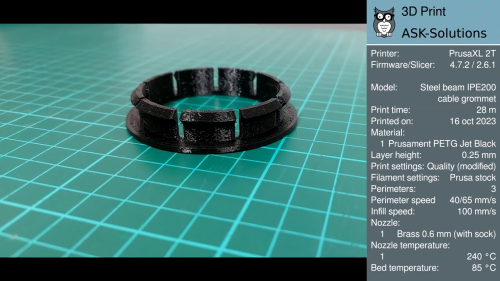
We used Prusament PETG Jet Black, a layer height of 0.25 millimetres and three perimeters to prevent unwanted gaps in the walls. The result was quite good, although the surface remained somewhat rough. The filament was not particularly dry, so drying it again was a logical next step. We did not compare it with dried filament in the video, so we cannot say whether that was the only cause.
This kind of small custom part is a good example of how 3D printing can be used in practice. There is first a concrete situation, then the necessary dimensions are determined, a design is created and the printed part can be checked in its actual application. What is learned in that process can then be captured in the design, print settings and documentation.
We used FreeCAD for the design. It allows us to work on our own computer and keep the files ourselves, without having to upload the design to a cloud service. That means we decide where the design files are stored and what we share. A cable grommet may not involve particularly sensitive information, but the same way of working remains useful for designs where ownership, confidentiality or long-term access to the source files matters more.
FreeCAD is free software and can be used without a paid subscription. The original design therefore remains available for study and further modification. Someone who wants to make the part again does not have to work only from the final result of our print, but can also examine how the model was constructed and adapt it to a different situation.
Important dimensions of this cable grommet are stored as parameters. If the hole is larger, the wall of the beam is thicker or the grommet needs to fit a different situation, those dimensions can be changed without rebuilding the design from scratch.
This means that we are sharing more than a printable file. Part of the reasoning behind the design remains accessible as well. The relationships between dimensions remain visible, and someone else can use the model as a starting point for their own variation. That makes the knowledge developed during the work easier to transfer.
We previously used the same approach for a mounting plate for a temporary doorbell, which had to fit without drilling new holes. We shared that FreeCAD design as well.
The design and print files for the cable grommet are available on Printables and GrabCAD. Before using the design yourself, always check its fit and suitability, and generate print instructions for your own printer and material; do not use someone else’s G-code blindly.
Our video from 19 December 2023 shows the explanation, the printing process and the result. More about designing, making parts and the practical use of different printing techniques can be found under 3D printing.
This practical example brings together several aspects that matter in this kind of work: investigating a concrete problem, designing a suitable solution, building knowledge while making it, and documenting the result in a way that allows others to understand, adapt and reuse it.
Copyright © 2026, ASK-Solutions · The Owl’s Nest is an initiative of ASK-Solutions


 Privacy Policy