
 ,
,


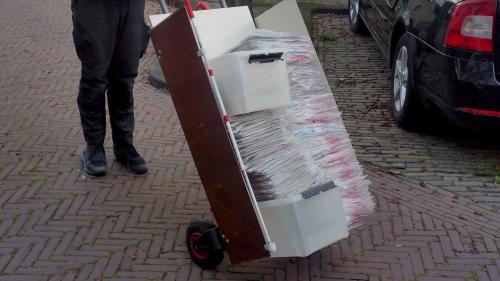
Regular delivery rounds is a project within ASK-Solutions’ implementation of The Owl’s Nest. Since 2017, regular delivery routes have been walked through Haarlem North. The core of the project is real delivery work: collecting or receiving materials, planning routes and making sure they reach the agreed addresses. Through this recurring activity, responsibility, physical activity, participation and contact within the neighbourhood take practical form.
The first route started on 16 August 2017, at the time as district 202105 within the then-current district system used by Netwerk VSP. The delivery round offered someone receiving support a concrete activity outside the home that returned every week. There were real addresses, materials that had to be delivered and a responsibility that did not disappear when a particular week was more difficult. Support was available where needed. The modest payment attached to this first route at the time remained with the person concerned in that situation as a small personal encouragement.
The scale, routes and clients have changed considerably over the years. For a long time, routes covered the area from the Schotersingel to the Zaanenlaan and from the Delftlaan to the Spaarndamseweg. The regular area is now slightly smaller, but deliveries are still made throughout a large part of Haarlem North. Other neighbourhoods are occasionally added, for example when covering for another delivery worker or carrying out an additional distribution round for a local business or organisation.
The materials being distributed come from the organisations and businesses for whom the deliveries are carried out. At present, this mainly consists of Spotta leaflet bundles requested by residents through the digital letterbox sticker at inmijnbus.nl, including personalised Folderkiezer bundles for individual addresses. Over the years, leaflets have also been distributed for local businesses, political parties, charities and associations. Previous clients have included Netwerk VSP, Buijze Pers, Rodi Media and Reclamediensten De Schakel, which was later taken over by All-Inn Verspreidingen.
For a delivery assignment, the client pays ASK-Solutions to distribute the materials within the agreed area. Carrying out these routes forms the practical core of the project and creates a recurring presence in different parts of Haarlem North. By walking through the same streets again and again, people begin to recognise one another, regular contacts develop and familiarity with what is happening in the neighbourhood gradually grows.
Residents and other people who know the delivery workers from their routes sometimes choose to give an amount to the foundation, for example around the Christmas period. These gifts grow out of the contact that has developed within the neighbourhood over the years and are received as donations to the foundation.
Which addresses receive materials varies with each assignment. The addresses determine where something needs to be delivered and therefore influence the route, but a much wider range of people is encountered along the way. The delivery workers move through public space and meet residents, neighbours, passers-by, postal workers, parcel and food delivery workers, and other people who are outside or busy around their homes.
Because the same streets are visited repeatedly, many faces become familiar and people also become known by name. A contact may remain no more than a greeting or a short conversation, or develop over time into a longer conversation, a practical question or another form of contact.
Small forms of practical help sometimes arise along the way as well. A bag of rubbish may be taken to a container, a letter posted, someone may ask for a message to be passed on or for brief help with something small. Other delivery workers, such as those working for PostNL, are also encountered regularly; sometimes someone walks in the same direction for part of a route and information or practical help is exchanged along the way.
Around Christmas, the delivery workers take along a Christmas card of their own from ASK-Solutions and its implementation of The Owl’s Nest for people they have come to know over the years on their regular routes. Where possible, the card is handed over personally and there is time to exchange a few words. By then, some residents have already put aside a card for the delivery workers or made one especially for them. These small, recurring gestures show how familiar many of the contacts along the routes have become.
Anyone walking through the same streets week after week also notices changes in public space. Accumulating litter, damage, vandalism, recurring nuisance or a situation in the street can therefore stand out more quickly. Small matters are cleaned up or dealt with directly where possible.
When something needs more attention, a concern can be passed on through the usual channels or someone can be pointed towards a place where appropriate information or help is available. The recurring presence also makes it easy for people to ask a question along the way or draw attention to something.
Over the years, changes in people’s lives also become visible. The delivery workers have seen people become ill and later recover, and have had to miss people who died through old age or illness. As a result, more and more encounters and stories become connected with streets, homes, shops and other places along the routes.
The delivery rounds are deliberately carried out on foot. A bicycle, moped or other faster means of delivery was not chosen because speed is not the main priority of the project. Walking through the neighbourhood leaves time to recognise people, stop for a conversation and remain attentive to what happens along the way. This recurring presence and contact with the neighbourhood are an important part of how the routes are carried out.
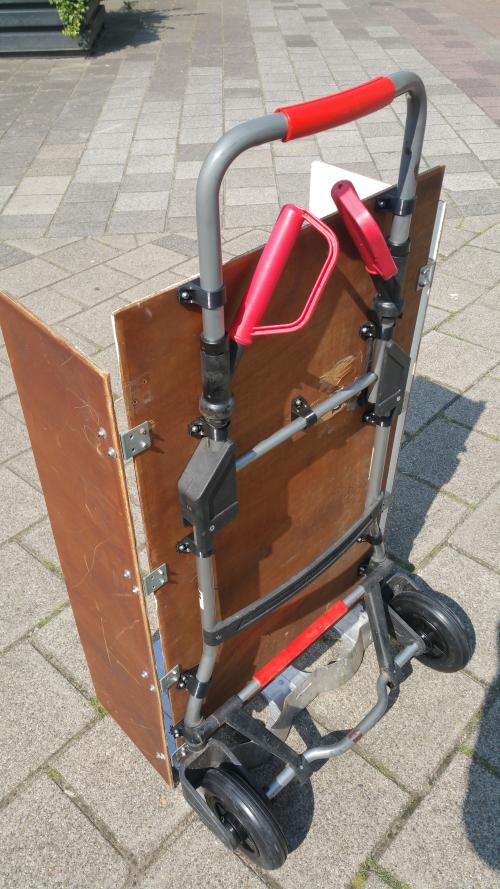
A delivery cart has been used for the materials from the beginning. The first version was simple and has gradually been adapted through use. Stronger side panels were added, the wheels were replaced with solid, soft-rubber versions and 3D-printed brackets were used to secure the construction more effectively. Dust and splash guards were designed and printed for the wheel bearings to help keep dirt and rain out.
The cart therefore develops along with the project. Problems become apparent through actual use and lead to repairs, modifications or a new design. Repairing, 3D printing, construction and testing all serve a concrete purpose here: creating a cart better suited to the routes for which it is used every week.
Many four-legged residents have also become familiar sights over the years. In several streets there are cats that recognise the cart and the people walking with it, and regularly come over to have a look or receive a stroke.
Sometimes this too calls for practical attention. A few cats have been returned to their owners or helped to find a new home. An injured animal may be noticed and reported to people or organisations able to help. These are small occurrences that naturally come with regularly walking through the same streets and paying attention to what is encountered along the way.
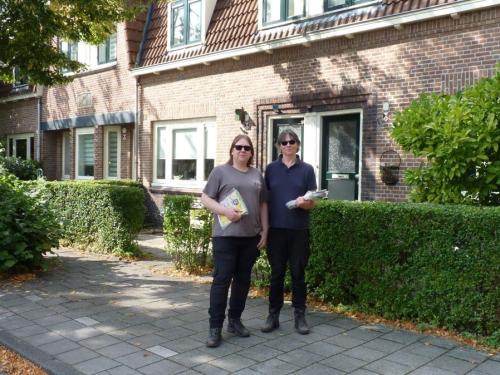
In 2025, De Rode Daken published an article about the delivery rounds and the contacts that have developed along the way. The article follows Laura and Bianca while they make their deliveries and describes what returning to the same neighbourhoods year after year means in practice.
Read “Laura en Bianca” on De Rode Daken…
Since 2017, the routes, clients, district boundaries, the location where materials for distribution are delivered, and the people involved in the project have changed several times. The delivery cart and the way the work is organised have also developed in response to practical experience.
The core has remained recognisable throughout: real delivery rounds that return regularly, require responsibility and repeatedly take people through the same surroundings. From that activity come contacts, practical experience, technical improvements and an ever-growing knowledge of the neighbourhood.
This project relates to several capabilities from the shared work model that forms part of the The Owl’s Nest project. These capabilities describe recognisable areas of knowledge, practical skills and facilities that may play a role in carrying out a project. Through Repair you can read more about what these capabilities mean and how their practical implementation may differ between operators and locations.
Copyright © 2026, ASK-Solutions · The Owl’s Nest is an initiative of ASK-Solutions


 Privacy Policy